
In its simplest context, Central Banks are responsible for overseeing the monetary system for a nation (or group of nations); however, central banks have a range of responsibilities, from overseeing monetary policy to implementing specific goals such as currency stability, low inflation and full employment.
Central banks also generally issue currency, function as the bank of the government, regulate the credit system, oversee commercial banks, manage exchange reserves and act as a lender of last resort.
There are eight major central banks today:
- US Federal Reserve Bank (US)
- European Central Bank (EUR)
- Bank of England (GBP)
- Bank of Japan (JPY)
- Swiss National Bank (CHF)
- Bank of Canada (CAD)
- Reserve Bank of Australia (AUD)
- Reserve Bank of New Zealand (NZD)
Central Banks and Interest Rates
The balancing act of stable employment and prices is a tricky one, and the main mechanism a central bank has to regulate these levels is interest rates. Interest rates are a primary influencer of investment flows.
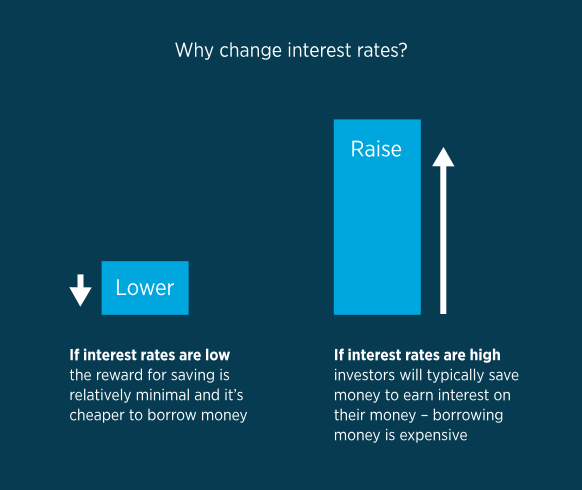
The reason for either raising or lowering the interest rate and why it has an influence is easy to see when you really think about it. Consider for a moment an economic environment where banks are concerned about the economy and are hesitant to loan money out of fear of not being paid back.
If interest rates are high, the safer option would be to keep the money and only loan to those whom they feel would pay back the loan at a high interest rate. An environment of this kind would make it difficult for small businesses that don’t have credit history to borrow money. Plus a higher cost to borrow may dissuade businesses from borrowing. The same would be true for individuals looking to buy houses.
If the same economic scenario were presented but interest rates were low, banks may feel that taking the risk in loaning to less-than-impeccable businesses is worth it, particularly since they could also borrow money from the central bank at extremely low rates. This would also lower the interest rates for buying a home.
Businesses borrowing money to grow their bottom line and individuals buying homes are two vital keys to a growing economy, and central banks typically try to encourage it. However, there are times when it gets a little out of control and too much risk is being taken, which can lead to painful economic downturns.
Central banks attempt to balance the needs of businesses and individuals by managing interest rates.
How interest rates influence traders
Traders are influenced by the rates at central banks as well. When buying one currency against another in a forex transaction, you are essentially taking ownership of that currency using the counter currency as the funds of your transaction. For instance, of you are buying the NZD/JPY (New Zealand Dollar/Japanese Yen), you are borrowing JPY to buy NZD. If you borrow, you pay the borrowing cost (interest rate) to get those funds, but on the flipside, you are earning interest on that which you bought. If the JPY has an interest rate of 0.10% and the NZD has interest rate of 2.50%, you are earning more interest than you are paying for the transaction.
Some investors take a long-term approach of borrowing low interest rate currencies and buying those with high interest rates, a strategy called the “carry trade.” While the carry trade can be profitable, when only considering the interest earned it is typically negligible. The values of the currencies against one another plays a much bigger role in the day-to-day profitability of the position, and can far outweigh any interest earned.




0 Comments